Vizhinjam EXIM operations began on August 18, 2026, marking a new phase for Kerala’s Vizhinjam International Seaport and India’s maritime trade network. The port has moved beyond its earlier transshipment role to begin handling export-import gateway cargo, giving Indian exporters and importers another direct connection to international shipping services.
For India’s maritime and logistics sector, the development matters because exporters and importers can now use Vizhinjam for gateway cargo instead of relying solely on overseas transshipment hubs. The change could influence shipping routes, logistics costs, inland connectivity and the development of industries around the port.
Vizhinjam EXIM Operations Move Beyond Transshipment
Vizhinjam was designed around its proximity to major international shipping routes and its ability to accommodate large container vessels. Its Phase I operations became commercially operational in December 2024, with an initial annual capacity of about 1 million TEUs. Vizhinjam EXIM operations now add a new dimension to the port’s role in India’s maritime trade.
Until now, the port’s main role was transshipment. In that model, cargo is transferred from one vessel to another at an intermediate port before continuing toward its destination. The expansion of Vizhinjam EXIM operations allows the port to serve more directly as a gateway for Indian exporters and importers.
The start of Vizhinjam EXIM operations changes that role. Indian exporters and importers can increasingly route cargo directly through Vizhinjam, creating a closer connection between Indian production centres and international shipping networks. This could make the port more important to India’s wider EXIM and logistics ecosystem.
The first commercial Vizhinjam EXIM operations were formally launched on August 18, with Kerala Chief Minister V. D. Satheesan flagging off containers from the port. The Kerala government also launched Mission Samudra, a wider initiative focused on developing the state’s maritime economy and integrating its ports and coastline.
For the longer term, the success of Vizhinjam EXIM operations will depend on cargo volumes, shipping-line participation, inland connectivity and the competitiveness of the overall logistics chain.
Why Gateway Operations Matter
The distinction between a transshipment hub and an EXIM gateway is important for businesses.
A gateway port connects directly with the domestic economy. Cargo arriving at the port can move into Indian supply chains, while export cargo can move from factories and distribution centres toward international vessels.
This can potentially reduce the need for some Indian cargo to travel through foreign transshipment hubs.
| Area | Earlier Vizhinjam role | Expanded EXIM role |
|---|---|---|
| Primary function | Transshipment | Transshipment and gateway cargo |
| Domestic connection | More limited | Direct link to Indian exporters and importers |
| International shipping | Major shipping-route access | Direct gateway access plus transshipment |
| Logistics opportunity | Port and vessel services | Port, freight, warehousing and multimodal logistics |
| Wider economic effect | Maritime activity | Potential broader trade and industrial development |
The actual savings in time and cost will vary by cargo, route, shipping line and inland transport connection. Businesses will therefore need to evaluate the complete logistics chain rather than the port alone.
The Port’s Location Is a Major Advantage
Vizhinjam’s strategic value comes partly from its location close to major east-west international shipping routes. Its deep-water characteristics also allow it to handle very large container ships.
The port has already attracted some of the world’s largest container vessels. Adani Ports reported that Vizhinjam crossed 2 million TEUs within 18 months of operations and had handled more than 950 vessels by June 2026. These are company-reported figures and should be viewed in that context.
Government information also points to a much larger capacity target. The combined capacity augmentation programme is intended to take annual capacity to 3 million TEUs, with potential throughput of up to 5.7 million TEUs through automation and operational efficiencies. Completion is targeted for December 2028.
That expansion will be important if gateway cargo volumes grow substantially.
From Port Infrastructure to a Wider Logistics Network
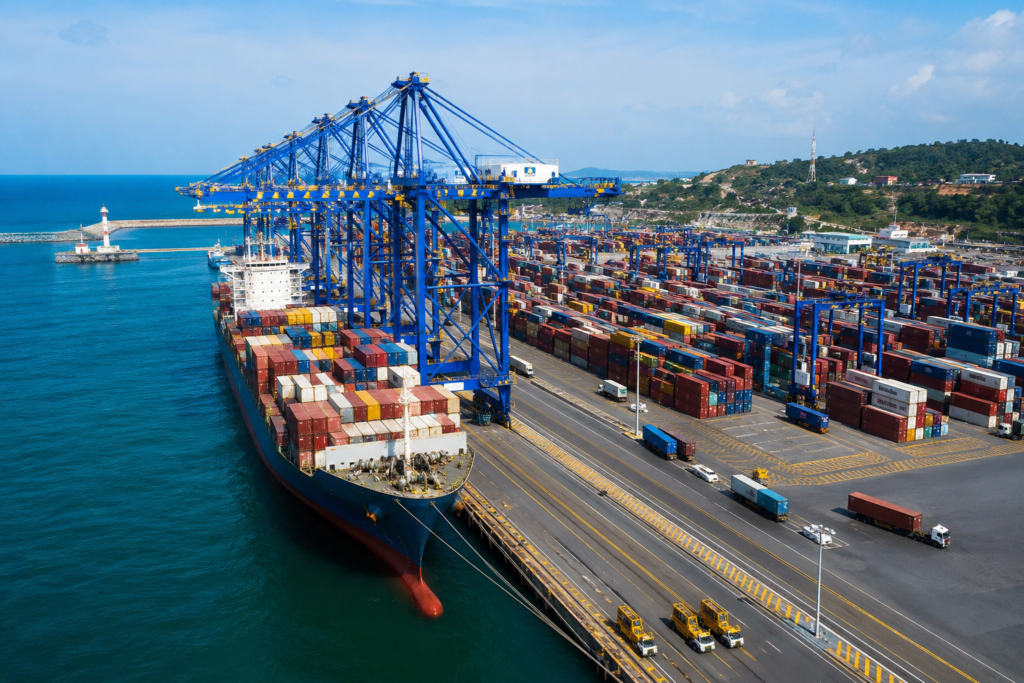
A port cannot operate as an isolated piece of infrastructure. Its economic value depends on the road, rail, warehousing, customs, freight-forwarding and distribution networks connected to it.
This is particularly important for manufacturers located away from the Kerala coast.
The opportunity for Vizhinjam extends beyond Kerala if freight operators can create efficient connections with industrial centres in southern and central India. Companies in sectors such as textiles, engineering, electronics, machinery and other export-oriented industries could potentially benefit from more routing options.
The development of supporting logistics infrastructure will therefore be an important part of the next phase.
Kerala has already approved a proposal for a multimodal logistics park near Vizhinjam. A government order records interest from the Container Corporation of India in establishing such a facility and links the project to the port’s planned capacity expansion.
What It Means for India’s Maritime Strategy
India has been seeking to strengthen its domestic maritime infrastructure and reduce dependence on foreign transshipment locations.
The government’s capacity expansion plans for Vizhinjam are part of that broader strategy. Official information says the expanded facility is expected to support larger container vessels and improve India’s position in international maritime trade.
For shipping lines, a successful gateway operation depends on cargo volumes and reliable services. For exporters and importers, the key issue will be whether direct routing provides a competitive combination of freight rates, transit times, reliability and inland connectivity.
For investors, the opportunity may therefore extend beyond the port itself.
Potential areas to watch include:
- Container freight and logistics services
- Warehousing and distribution
- Multimodal transport
- Customs and freight-forwarding services
- Port-related technology
- Container yards and cargo facilities
- Industrial development around logistics corridors
What Vizhinjam EXIM Operations Mean for Future Growth
The launch of EXIM operations is an important operational milestone, but it is not the final measure of Vizhinjam’s success.
The next test will be whether the port can attract sustained gateway cargo and build efficient connections with exporters, importers, shipping lines and inland logistics providers.
The planned expansion provides significant room for growth. At the same time, higher capacity will need corresponding cargo demand and supporting infrastructure.
For water-mobility professionals, the development is significant because it shows how a modern port can combine transshipment, gateway cargo, automation and multimodal logistics.
For EXIM businesses, the key question is more practical: can Vizhinjam become a consistently competitive alternative for moving Indian cargo through international shipping networks?
For investors and entrepreneurs, the answer may create opportunities well beyond the port boundary.
[CTA: Explore more Global News Scan coverage of India’s evolving mobility and logistics infrastructure.]
What to Watch Next
The most important indicators over the next several years will be actual cargo volumes, shipping-line participation, inland connectivity and the pace of capacity expansion.
Particular attention should be given to:
- Growth in direct EXIM container volumes
- New shipping services calling at Vizhinjam
- Development of multimodal logistics facilities
- Connectivity with southern India’s industrial centres
- Progress of the planned capacity expansion
- Port-related investment and industrial activity
- Actual logistics costs and transit-time changes for exporters
Vizhinjam’s EXIM launch does not immediately transform India’s maritime logistics system. It does, however, add a new direct gateway at a strategically important location.
If cargo volumes, shipping services and inland infrastructure develop together, Vizhinjam could become an increasingly important part of India’s international trade network.
Frequently Asked Questions
What changed at Vizhinjam Port on August 18, 2026?
Vizhinjam began full export-import gateway operations, expanding its role beyond transshipment.
Why is Vizhinjam important for Indian exporters?
It provides another direct maritime gateway through which Indian export cargo can connect with international shipping networks.
What is the difference between EXIM and transshipment?
EXIM gateway operations connect cargo directly with a country’s import and export supply chains, while transshipment involves transferring cargo between vessels at an intermediate port.
How large can Vizhinjam become?
Government plans target annual capacity of 3 million TEUs, with potential throughput of up to 5.7 million TEUs after capacity expansion and operational improvements.
What should businesses watch after the EXIM launch?
Cargo volumes, shipping services, inland connectivity, logistics costs and the development of supporting warehousing and multimodal infrastructure will be key indicators.
Read More at Global News Scan for the latest Mobility News and maritime infrastructure developments.
Sources
- New Indian Express, “Mission Samudra, EXIM ops at Vizhinjam launched”
- NDTV Profit, “Vizhinjam Port Begins Full-Fledged Export-Import Operations”
- Press Information Bureau, Ministry of Ports, Shipping and Waterways, Vizhinjam development
- Press Information Bureau, Ministry of Ports, Shipping and Waterways, Vizhinjam capacity augmentation
- Adani Ports, Vizhinjam and MSC partnership announcement
- Government of Kerala, Multimodal Logistics Park order